Gold's Historic Rally in 2025: Four Forces Driving the Run to $4,200
A convergence of domestic and global forces are powering gold's record rise.
John G T Slater, Jr
Managing Member
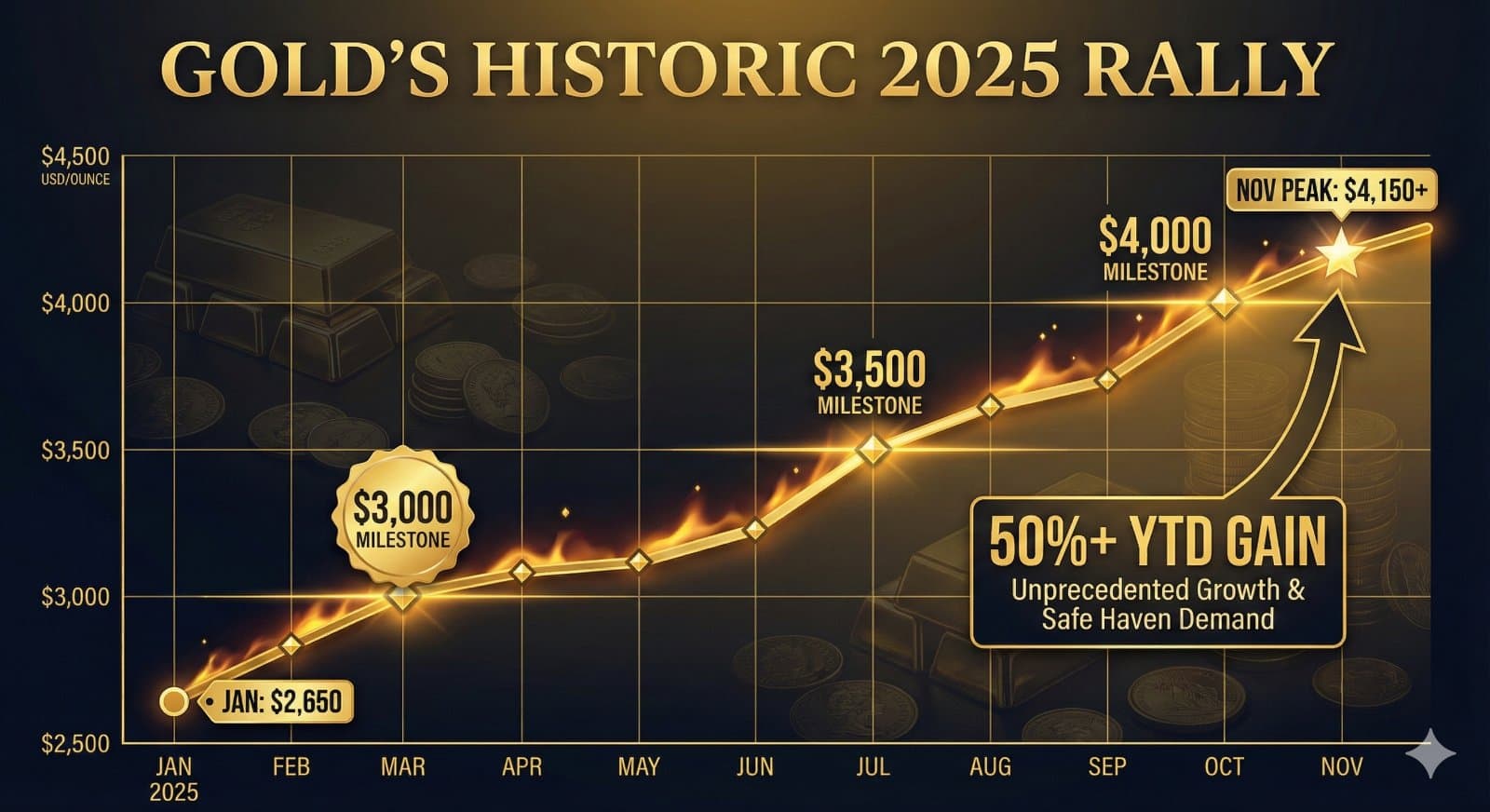
Gold's Astonishing 2025: Understanding the 50%+ Rally to $4,200/oz
Gold has delivered one of its most remarkable performances in decades, surging more than 50% in 2025 to reach unprecedented heights above $4,200 per ounce. For investors accustomed to gold's traditional role as a portfolio stabilizer rather than a growth engine, this year's rally has been nothing short of extraordinary. Understanding what's driving this meteoric rise—and whether it changes how we should think about gold allocations—has become essential for prudent portfolio management.
Four Powerful Forces Converging
The gold rally isn't driven by a single factor but rather the convergence of four powerful dynamics. First, persistent inflation concerns continue to elevate gold's appeal as a hedge against currency debasement. Despite the Federal Reserve's efforts to bring inflation back to its 2% target, headline CPI has remained stubbornly elevated at 2.7%, keeping investors wary about the long-term purchasing power of cash and bonds.
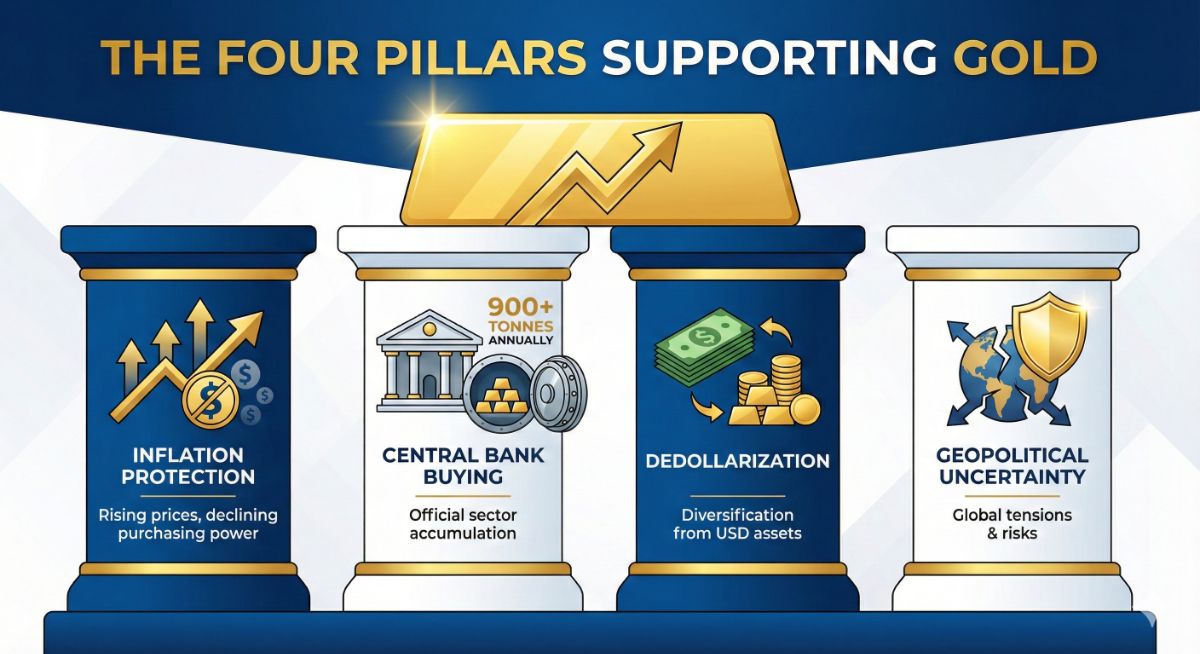
Second, central bank gold purchases have reached historic proportions. Global central banks are expected to acquire approximately 900 tonnes of gold in 2025, continuing a multi-year trend of diversification away from U.S. dollar reserves. This structural demand from official sector buyers—who are largely price-insensitive and focused on long-term strategic positioning—has provided a solid floor under prices.
Third, the accelerating trend toward de-dollarization has emerged as a critical driver. The U.S. dollar's share of global reserves has declined to approximately 57.8%, continuing a multi-year downward trajectory as nations seek alternatives to dollar dependency. This systematic diversification away from dollar-denominated assets has positioned gold as the primary beneficiary, with central banks viewing the metal as a neutral reserve asset free from geopolitical risk.
Fourth, geopolitical uncertainty and trade tensions have amplified gold's safe-haven appeal. From ongoing conflicts to unpredictable policy shifts, investors are seeking assets that offer protection regardless of which way political winds blow. Gold's 5,000-year track record as a store of value during times of upheaval makes it uniquely suited for this moment.
The Allocation Question
Recent research from major financial institutions suggests that gold allocations between 2% and 10% of a portfolio can enhance risk-adjusted returns while reducing drawdowns. Analysis covering the 2005-2025 period demonstrates that these modest allocations improved overall portfolio performance, decreased volatility, and provided meaningful diversification benefits during equity market stress.
But does this year's explosive rally change the calculus? History offers important perspective. Gold's current surge, while impressive, isn't unprecedented. The metal rose dramatically during previous periods of monetary transition and currency uncertainty. What makes 2025 notable is the confluence of factors—inflation persistence, central bank accumulation, de-dollarization momentum, and geopolitical instability—all reinforcing each other simultaneously.
What Makes Sense for Your Portfolio?
For most investors, gold should serve as portfolio insurance rather than a speculation. The 2-10% allocation range recommended by recent research remains sound, even at current elevated prices. Here's why: gold's primary value isn't its ability to generate returns but its low correlation to traditional assets and its performance during periods of financial stress or currency debasement.
Investors who have maintained consistent gold allocations through the years have been rewarded not just by 2025's rally but by the steady diversification benefits gold provides over complete market cycles. Those without any gold exposure face a more challenging decision—is this the right time to establish a position, or should they wait for a pullback?
The answer likely depends on your investment horizon and risk tolerance. For long-term investors with 10+ year time horizons, establishing a modest 2-5% allocation even at current prices may prove prudent. Markets don't typically offer perfect entry points, and the structural factors supporting gold—central bank buying, de-dollarization trends, geopolitical uncertainty, and inflation concerns—show little sign of abating.
Gold's 2025 performance reminds us that diversification isn't just about smoothing returns—it's about having assets that can surprise to the upside when market narratives shift. Whether gold continues climbing or pauses to consolidate, its role as a strategic portfolio holding remains as relevant as ever.
References:
CNBC - Gold heads for fourth monthly gain; silver hits fresh record high (spot gold at $4,192.78/oz, set for 4.6% monthly gain and fourth consecutive monthly gain)
J.P. Morgan Research - Gold price predictions (prices expected to average $3,675/oz by Q4 2025, climb toward $4,000 by mid-2026, central bank buying around 900 tonnes in 2025, central banks globally hold nearly 36,200 tonnes accounting for almost 20% of official reserves up from around 15% at end of 2023)
J.P. Morgan Research - De-dollarization trends (USD share of global reserves at 57.8%, marking 0.62 percentage point decline, diversification away from USD reserve holdings accelerating, with economic, trade and U.S. policy uncertainty driving further diversification into gold)
Weekend Reading For Financial Planners - November 29, 2025 (gold up more than 50% in 2025, State Street research showing 2-10% allocation improved returns, reduced volatility, and shallower drawdowns from 2005-2025)
Edward Jones Weekly Market Update - November 28, 2025 (S&P 500 up 15% YTD, MSCI All Country World ex-US up 23%, WTI oil averaged $65/barrel down from $76 last year, headline CPI decelerating from 3% in 2024 to 2.7% in 2025)
Fortune.com articles noting historical context (1971-2024 stocks averaged 10.7% annual returns vs gold's 7.9%, but gold serves as safe-haven during uncertainty)
Tags
Disclaimer: CUBIC Advisors and its clients may hold positions in, and may trade, securities of companies discussed in these blog posts. The information provided is for educational and informational purposes only and should not be construed as financial, investment, retirement, tax, or legal advice. Readers should consult with their own qualified advisors before making any financial decisions. Past performance does not guarantee future results.